So what does “Get Traffic” mean? Well its all about visitors. You need people to get to your site. Now there are three ways you can let people know about your website:
2 out of the 3 ways above are complete waste of time when it comes to promoting a start up website. All three may work for other types of start ups but for websites only one works – do you know which one?
Well I’ll stop you guessing – its number 3 online. The reasons why 1 & 2 don’t work and number 3 does is because:
So statistically you’ve only got 3 chances to get that visitor. But this all depends on someone actually acting upon someone else’s recommendation of your website. How many times have you been given a recommendation of a website and either forgotten what it is or never acted on it anyway? Again statistics show its around 9 out of 10 times you either forget or have no interest in visitng the site.
So equating the likelihood of someone:
and actually landing at your site is pretty slim. Some will find their way to your site but there are too many things that can go wrong or simply not occur for them to actually end up at your site which make word of mouth promotions ineffective.
Its like if you were advertising a plasma TV over the TV networks such as ITV, Channel 4 or Sky, you can safely assume that the viewers have at least a TV otherwise they would not be able to view your advert. So you can say safely say that the viewer could at some point be interested in the TV that is being advertised because they have a TV.. It’s the same with websites. If you promote a website on someone elses website you can assume that the reader of someone elses website could be interested in your website because they are actually able to view your website because they have a computer! Do you catch my drift?
There is no need to try and convert people to the internet. Let Tesco, Amazon or whoever else that has billions to do this. All you want are people who have regular access to a computer with an internet connection and use it so. So by advertising by methods 1 or 2 may create interest in your site but will not actually result in any visitors to your site. If you have no visitors then no matter how great your site looks ITS NOT A WEBSITE – IT’S A PAINTING!
So hopefully you’ll agree with me the ONLY way to promote your website is online. So how do you do it online? Well you do it on a little known site called “Google” using their clever program Google Adwords.
Google Adwords
Google allows you to display a small 3 line advert on the right hand side of their page when someone searches for a search term that you have specified. Its called The Google Adwords Program. If the searcher sees your advert and clicks on your advert they will land on your home page and google will charge you anywhere from 1p to your maximum price which you can specify.
How Google Adwords Works
Well guess what? – Google is the NEW Landlord & Newspaper!
Google Landlord - This landlord is different. He lets you rent for free. He lets you set up shop and only charge you for when a customer enters your shop (i.e. when the user clicks on your advert)! Can you imagine that? A landlord that lets you have a shop for free, NO RENT or council taxes and no service charges. He only charges you when a customer enters your shop.
Google Newspaper – This newspaper is different. He lets you advertise for free. Only ever charging you when a reader RESPONDS to your advert. Try running that one by the SUNDAY TIMES!
But it gets even better. The more RELEVANT your ad the more likely it is to be ‘aired’ and the LESS you have to pay. Why?
Well, when Google first started, way back in 1998 (which was only 9 years ago – a lifetime on the net), they were the first search engine that produced relevant results.
So while Yahoo and AltaVista were search engines AS WELL AS re-sellers of goods, Google were just damn good result providers. So by 2004 they became the most used search engine because of the way their programs worked.
So Google’s USP (Unique Selling Point) was that they were relevant. Relevancy is key to the success of any search engine. What is the point of visiting a search engine if all they produce irrelevant results? So relevancy is what they demand off any advertiser also.
So the key is to be relevant!
RELEVANCY
So how do you be relevant? The best way to be relevant is to KNOW YOUR CUSTOMER. There is a really easy way to know your customer. All you have to do is work out what your customer wants by the way they search.
If you know what they search and all variations of it then you’re ad will show. With a well written ad you’ll get chosen. If you get chosen consistently then you MUST be relevant!
Google have a neat way of deciding on whether you are relevant. Its called the:
CLICK THRU RATE (CTR)
This means:
Think about it. If you do get clicked thru based on the search term 100 times out of every 100 times you are displayed then you must be very relevant to what is being searched. Google will love you as you follow their mission statement of Google which is:
So if you are following Google’s mission statement then Google feel obliged to reward you. The way they reward you is to charge you LESS the MORE relevant you are. They do this by working out your Google Score.
Your Google score is determined as:
So Company A has a higher Google Score than Company B. So even though Company B is willing to pay £2 per click Company A still ranks higher and pays only £1 for the click.
But it gets even better! All Company A has to do to beat Company B is get a score greater than 2. If they can maintain a CTR of 100% and pay a cost per click of 10p then their score is:
This is greater than Company B.
So in this extreme example company A pays only 10p and gets ranked first. So what does company B pay? Well Google have another rule:
So if you introduce company C & company D who have a click thru rate of 10% and are willing to pay 50p and 5p per click you have their Google score at:
So the cost per clicks (known as CPC) are as follows:
So companies A, B, C & D can be identified as these following typical companies:
Now I have helped many people with their “Pay Per Click” PPC campaigns and most fall in to The Amateur or The Poor category. Very few were in The Lazy category because I had very few clients that had budgets of greater than £100,000 per month But they ALL had one mission in mind: They wanted to be in The Winner category.
We all know in life that not everyone can be the winner. To be the winner requires you being better than your competitors. The information below will help you become the winner. I still sell this information below as an eBook for £60 on one of my websites but I am giving you this for free. Its called “MASTERING THE ART OF GOOGLE ADWORDS”. Most website creators cannot be bothered to master Google Adwords as they do not appreciate how effective it can be. I hope you will not behave like most website creators. However if you’re of the lazy type then skip this section and read later on in this chapter in the section called “The lazy mans guide to Google Adwords”.
Mastering The Art Of Google Adwords
Firstly you need to open a google adwords account. To do this visit:
It’s fairly simple to open an account and use. One thing you can always be assured of with Google and that is useability. Its very easy to get your adverts on to google. I see plenty of badly worded adverts which I am sure never get clicked. If these idiots can use google adwords I’m quite sure you can!
The difficult bit is getting them aired enough and get them clicked enough. This is what I want to focus on because this is the difficult bit.
Know Your Customers
In this section forget about me, me, me its YOU, YOU, YOU! Or to rephrase correctly its less about you, you, you and more about THEM, THEM, THEM! Them being your customers.
Who are the type of people that are willing to BUY off you? You really need to understand THEM. Its THEM who pay your bills so you better get to know THEM. The way to identify them is to know who would want your product or service. If you’re selling a property refurbishment service then you can be assured that the following traits exist from a potential customer:
You can also make some wilder judgements like:
This is a small list. The idea is just sit back and think about who would actually purchase your product or service. Don’t have blind belief that your product is so great that everyone would as the truth is that the majority won’t!
Here, Steve clearly understood the customer of 2 large pizzas!
Here’s a checklist of prompters that will help you establish some of the traits of your typical customer:
You can find this worksheet at: www.MassiveAndPassive.co.uk/worksheets.html
Based on the answers to these questions and more you should be able to create a pool of traits of your typical customer. I’m sorry if this sounds like a marketing diploma but the diploma is there for a reason (I’ve never studied for one but they make excellent points!). Once you have a pool of traits we can start building REAL PEOPLE out of these and start segregating the customers.
Segregate Customers
So we have a whole load of traits – what do we do with them? Well we can group traits together to build up a typical customer and give them a name. This is probably the most difficult thing to do. This requires really understanding your product and picturing the type of people that would buy your product.
Well lets say I was marketing this chapter about “how to get traffic to your website” as an eBook. I would need to know my product inside out and I would need to have an idea about my potential customers. Well I know my product and I think I know my customers. Based on my understanding of my product (being this chapter) I have come up with the following customer types for my product of “how to get more traffic to your website” with their associated motives:
It took me a long time to come up with this. About a days thinking. But it is important that you do give this part of the exercise some real thought. Use this worksheet to help you:
You can find this worksheet at: www.MassiveAndPassive.co.uk/worksheets.html
You need to know who your customer is and why they want to buy your product. So for example if you are a retailer of video games then your customer categories and motives may be:
So you can see that these 3 customer types are very different with differing motives. We can use these differing motives to construct well targeted ads so we can capture all 3 types. But before we get to the ads we can further segregate the customer. Read on…..
Cater For Personalities
We are not robots. We are all different in our own way. We have personalities. This becomes a big problem if you’re trying to get your customer to respond to you! If I knew your personality then it would be easy to get you to respond. So for example if I know you’re a bit of a perfectionist and you think you’re ahead of the game then I might run an ad that says:
Perfect Your PPC
Masterclass in AdWords
Not For Novices – Join NOW
www.MassiveAndPassive.co.uk
This ad might work well with you but not so well with others. If I spent all day thinking up personality types my Google Adword campaign would take for ever to compile. Since we do not have an unlimited amount of time to compile personality types we have to think of a more base level type.
In my experience in business I meet a lot of business people. There are the formal types and the informal types. They are very different and the difference between them, I think, is enough to further segregate. They respond differently enough which helps me target them differently.
The formal types – I picture this customer in a shirt and tie. He refers to his customers as clients, his income as fees and his costs as expenditure. He follows the rules.
The informal types – I picture this customer in jeans and a T-shirt. He works funny hours, bends the rules to get the job done and takes bigger risks.
So we can compile our likely set of customers:
So we have 8 customer types. Now I know my customer types I can try to connect with them as best I can. I will picture each one of these customer types sitting in front of the computer and try to write an ad so they respond.
Think about a base level personality which will help you dissect your customer base. Example dissections could be:
The list can go on. It has to be a sensible dissection that is relevant to your product or service. You can dissect in to more than 2 groups. The more you dissect the better understanding of your customer you will have. Example dissections could be:
But remember – the more you dissect the more ads you will have to write. This will be obvious as you read further.
Number Of Customer Types
So based on this chapter and the last chapter you will be able to determine the number of customer types. Its simply:
Number Of Customer Categories x Number of Personalities = Number of Customer Types
So in my case its 4 x 2 = 8
Since there are 8 different customer types I’m going to have to write 8 different ads. Each customer deserves their own ad as each customer type is different as established through the workings above.
But before we start writing the ads we need to learn a little about ad types. Read on….
Cater For Ad Types
Here is what Michael Fortin thinks about writing ads.
Michel Fortin is a direct response copywriter, author, speaker and consultant. His specialty are long copy sales letters and websites. Watch him rewrite copy on video each month, and get tips and tested conversion strategies proven to boost response in his membership site at http://TheCopyDoctor.com/ today.
Article Source: http://EzineArticles.com/
When writing direct response copy, there are a few things that can maximize the responsiveness of your message. The first and most important element that can turn any website, salesletter or ad into an action-generating mechanism is the headline.
A headline is meant to do two vital things.
First, it needs to grab your reader's attention. Realize that people surfing the web are click-happy. They tend to scan web pages quickly, even many of them simultaneously. Your site is but a blur. So, your headline must be prominent and effective enough to stop them.
Second, your headline needs pull the reader into the copy and compel her into reading further. To do that, it must cater to a specific emotion or a relevant condition -- one to which the reader can easily associate. Here's a list of "triggers," coupled with actual examples I used in the past:
· Curiosity ("Revealed! Closely Guarded Secrets For ...")
· Mystery ("The Five Biggest Mistakes to Avoid By ...")
· Fear ("Over 98.4% of People End up Broke When ...")
· Pain ("Suffering From Needless Back Pain? Then ...")
· Convenience ("How to Increase Your Chances With ...")
· Envy ("How Fellow Marketer Pummels Competitors By ...")
· Jealousy ("They All Laughed When ... Until I ...")
· Sloth ("Slash Your Learning Curve By 57% When ...")
· Love, Lust ("Make Her Fall in Love With You With ...")
· Shock ("Finally Exposed! Get The Dirty Truth On ...")
· Greed ("Boost Your Income By More Than 317% When ...")
· Pride, Power, Ego ("Make Fellow Workers Squirm With ...")
· Assurance ("... In Less Than 60 Days, Guaranteed!")
· Immortality ("Reverse The Aging Process With ...")
· Anger ("Banks Are Ripping You Off! Here's Why ...")
By the way, most of these headlines were enormously successful for my clients, not because they were tested and tweaked (and most of them were), but because they were actually stolen from other, equally successful ads or salesletters. All "great" copywriters do this. They steal. They recycle. They copy. They model. They swipe.
And they adapt.
Of course, they must not be copied literally. (There's a big difference between plagiarism and modelling.) But they can be easily adapted to fit the market, the offer and the message. I have a large swipe file that contains copies of ads, websites, direct mail pieces and salesletters I come across. I then turn them into templates or "fill-in-the-blanks" formulas.
Study and model successful copywriting as much as you can. Dan Kennedy, my mentor and a hugely successful copywriter, teaches his students this exercise: buy tabloids, such as The National Enquirer, on a regular basis. Of course, the publication may be questionable for some, and it may not necessarily fit with your style or cater to your market.
But here's the reason why.
Ad space in tabloids is excruciatingly expensive. If an ad is repeated in more than two issues, preferably copy-intense ads or full-page advertorials, common sense tells you that the ad is profitable. Rip out the ad and put it into your swipe file. (If you don't have one, a shortcut is to copy someone else's, or swipe from proven list of successful headlines.)
Then, copy the headlines into a document. They can be easily converted into "fill-in-the-blanks" formulas. And believe me, they work well with almost all markets. I've tried these types of headlines on both low-end and high-end clients, from simple $10 products to six-figure investment opportunities. And they worked quite effectively in both situations.
The cosmetics of a headline is equally important if not more so. The type must be bold, large and prominently placed, even written in a different font or typestyle. It must "scream" at your readers. Don't worry if it's too harsh or too long. (My experience tells me that the longer headlines pull the most, even for professional clients or in conservative situations.)
Specificity is also quite important. The more specific you are with your headline, the better the response will be. Use odd, non-rounded numbers because they are more believable and pull more than even, rounded numbers. (In its commercials, Ivory Soap used to say it's "99.44% pure." Of course, that number is more believable than "100%.")
Whenever possible, be quantifiable, measurable and time-bound. For example, you're promoting some "how-to" marketing program. Don't say, "increase your income" or "make money fast." Words like "income" and "fast" are vague. Be specific. Say, "How six simple sales strategies helped me stumble onto an unexpected $5,431.96 windfall -- in less than 27 hours!"
The bigger the numbers are, the greater the impact is. If you say "five times more," replace it with "500%" (or better yet, "517%" or "483%"). Don't say "one year," say "364 days." The brain thinks in pictures, not numbers or words. Both "terms may mean the same thing, but one looks bigger.
Using some of the triggers mentioned at the beginning, here are some examples of being specific with your headlines:
· "Nine Jealously Guarded Techniques That ..."
· "Here Are 17 of My Most Prized Recipes For ..."
· "How I Made $42,791.36 in Only 11 Days With ..."
· "Boost Your Golf Drives By 27 Yards When ..."
· "A Whole New Way to Lose 45 Pounds in 7 Weeks With ..."
· "Marketing Toolkit Contains 35 Powertools That ..."
· "Follow These Eight Magical Steps to ..."
· "Read This 22-Chapter, 376-Page Powerhouse ..."
· "The 10 Commandments of Power Positioning ..."
· "Chop Paperwork By as Much as 47% When ..."
· "Slash Your Learning Curve By Four Weeks With ..."
· "... And Start Using Within Only 33 Minutes!"
My favorite headline formula is the "gapper," which is based on the pain-pleasure principle. In sales, it's referred to as "gap analysis." (Dan Kennedy calls it "Problem-Agitate-Solve." That is, you start by presenting a problem, you agitate your audience by making the problem "bigger," more significant and more urgent, and then you present your solution in the offer.)
With the "gapper," there's a gap between a prospect's problem and its solution (or a gap between where one happens to be at the moment and where that person wants to be in the future). But many prospects either do not know there is in fact a gap or, because it is one, naturally have a tendency to ignore it. It's simply human nature.
So, a headline that communicates the presence of such a gap -- or one that widens it (which can also be accomplished through other components, such as a surheadline, subheadline, "lift" copy, sidenotes or opening statements) -- will likely appeal to those who can immediately relate to it (i.e., people within that specific site's target market).
By opening the gap or widening it helps to reinforce a sense of urgency in the mind. After the headline, visitors will want to know how, by browsing further, they can close that gap. And the wider the gap is, the greater the desire to close it will be. Why? Because it appeals to stronger motives.
Abraham Maslow, the famous psychologist who developed the hierarchy of human motives, stated that the foundation of all human needs is our need to survive. Once satisfied, the next one is our need for safety. Our need to be with other people is next, followed by our need to feel appreciated. Finally, our need to be challenged is at the top.
The "pain-pleasure principle" states that people either fear pain (and try to avoid it) or crave pleasure (and try to gain it). When given a choice between the two, however, pain is a superior motive. Our need to survive and feel safe, which are at the bottom of Maslow's pyramid, rule over all other needs.
So, a headline that instantly communicates a problem (i.e., a painful situation or a potentially painful one that may arise without the benefits of your offering) will have more impact. People who associate with the message will feel compelled to read more, which also helps to qualifiy your readers -- it isolates the "serious" from the "curious."
You heard it before: there's a difference between "needs" and "wants." When I work with plastic surgeons, I often tell them to use as a headline, "Suffering from wrinkles?" That way, it pulls only qualified prospects into the ad because it appeals not only to people with wrinkles but also to those who suffer from wrinkles (i.e., they want to do something about them).
A web salesletter I recently wrote for Michael Murray talks about the fact that he is a college student stricken with cerebral palsy who's "made it" online. The copy and most of the headers use some of the triggers I mentioned earlier.
Below is a brief list. Can you identify them?
· "SPECIAL REPORT! Want to cash in on ..."
· "... But don't have a product or a website?"
· "How a 'Physically Disabled' Teenager ..."
· "Earn a $2,000-to-17,000 Monthly Downpour of Dollars ..."
· "... On a Shoestring Budget!"
· "Jealously guarded 'secrets' are finally revealed ..."
· "Get your hands on dirt-cheap products to sell ..."
· "You'll never have to create your own products!"
· "... Model after actual websites 'making it' BIG TIME!"
· "PLUS, for a limited time only, the next 500 orders ..."
· "And if I can do it, I'm sure most 'abled' people can!"
Michael is a 19-year old with cerebral palsy. (I was moved by his story.) With his headline specifically, I used strategies to increase the attention factor. My biggest concern was the fact that people have become desensitized with opportunities of this nature. So, while I catered to people's emotions, I used Michael's disability as a psychological "hook."
Ultimately, ask yourself: "Does my headline effectively stop people from scanning my web page, capture their attention and trigger their emotions in order to pull them into the copy?" More importantly, ask yourself, "Does my opening statement beg for attention, arouse curiosity and genuinely cater to the motives and emotions of my market?"
If not, change your headline and try different ones. Sure, the change may be small and insignificant. But often, the smallest changes can create the most dramatic changes in your results.
This article shows us there are two forms of ad types:
Trigger Compulsion
This is where you connect with the reader through sparking an emotion and then compelling them to read further.
Pain Pleasure
This is where you identify with the reader’s problem (pain) and then present them with the solution (pleasure).
Ad Creator Worksheet
So for my product I have to come up with phrases that match each type of ad for each type of customer. I use the worksheet below to throw in suitable phrases or words that might be used in my ad. At this point I do not worry about the character restrictions set by Google. This is just a worksheet where I put my ideas down.
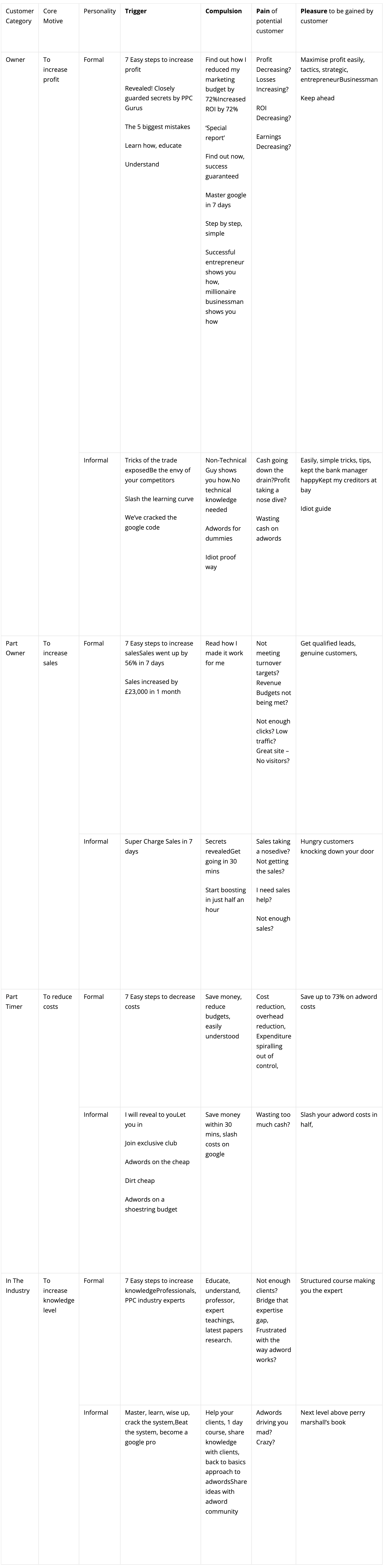
Just let your mind run free. It’s a landing ground for ANY idea phrase or word you have no matter how stupid it sounds. Sometimes the more stupid it is the more noticeable it is to the potential customer!
Now once you’ve got all your ideas down I suggest you print it out. You will need to refer to this when constructing your ad so instead of scrolling up and down its best to have this print out in front of your computer screen when drafting your ads.
You can use this worksheet below to help you. You can find it at:
www.MassiveAndPassive.co.uk/worksheets.html
Once you have filled this in then you can move on to constructing the ads.
Write Ad
I would say this is the hardest part of the exercise. It takes a lot of patience and creativity to come up with ads that attract attention. You need to have your Ad Creator Worksheet in front of you, a nice cup of tea and your creativity cap firmly ON!
Here’s what I came up with:
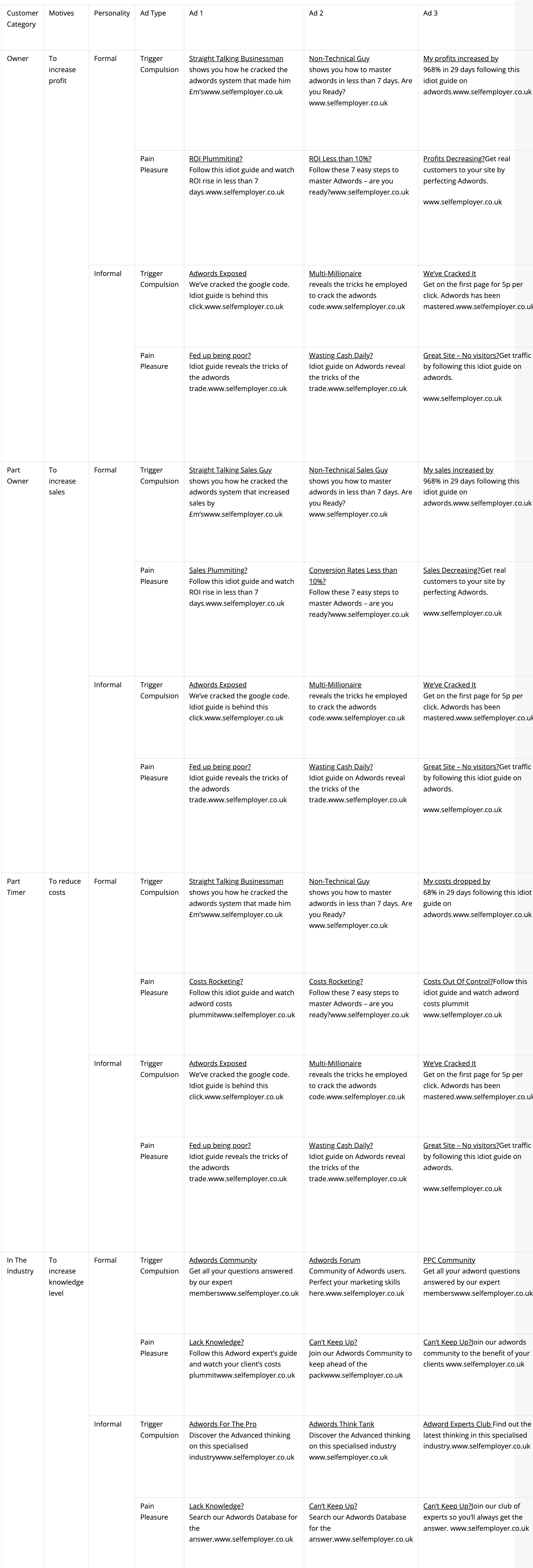
Again I have ignored character restrictions set by google but I have tried to keep it brief. I will simply re-edit the ads once I’m in google adwords itself. Now I have followed the trigger compulsion and pain pleasure methods quite religiously. This is because it WORKS! So do not be tempted to deviate from this simply because you cant be bothered. If you’ve hit a mental block then simply switch your computer off and then come back to it. There is no point in rushing through an ad. What will happen is that your ad simply wont get clicked and your CTR will plummit.
I’ve tried to write as many different type of ads as possible but you will notice similarities in my set of ads. The reason for this is its damn hard to come up with 48 individual looking ads! I think my set of ads are different enough however to result in differing click thru rates.
Important Message
Some ads will work and some will not.·
This is dealt with in section 7 but its important to note now. It is good to write ads that are significantly different to see which ones work. Then you can start narrowing the difference over time for the ones that do work
Allocate Search terms For Each Ad Group
For the ad to get clicked its got to appeal to the reader. If its written in a way that appeals to you because of the way you are and the search term is in the ad then BINGO! You have a very good chance of being clicked. So if I was a formal business person fed up with paying a fortune to google and I searched ‘adwords profits’ and my ad was written in a formal trigger compulsion format like:
Profits Decreasing?
Get real customers to your
site by perfecting Adwords
www.selfemployer.co.uk
He would see that every word he searched was in my ad. This is because Google display it in bold if it matches. This will direct the searcher to my ad. Then the searcher sees that I speak their language. There is mention of typical business terms like decreasing (instead of less) and Profits (instead of sales or costs). The searcher will think that I have got what he wants and speaks their language.
Getting the key words
So how do you get the keywords? Well it’s a two stage process:
To get the popular keywords and phrases surrounding a subject you simply find out, using generic terms, what is being searched. You do this by cheating! I know a site where you type in a search term and it will tell you how many times this search time and related search terms have been searched for in the previous month.
Visit: www.MassiveAndPassive.co.uk/get-keywords.html
Type in a generic term surrounding your industry and you’ll get all the phrases that have been commonly searched. So in my example my industry is the Pay Per Click Industry. So common generic keywords will be:
This site generates 100 key phrases per term searched. The site came up with the following search terms and number of searches:
Now with these 400 keywords and phrases the site has generated you simply cut and paste them for each ad group. You will find that may be only 200 or so of them are relevant so only use the ones that are relevant.
You can only include one keyword phrase for one ad group. In other words each keyword or phrase is mutually exclusive. No ad group can have the same keyword or phrase.
The way you decide which keyword or phrase goes with which ad group is based on what the keyword or phrase is. So if the key phrase is ‘Marketing Consultant’ then considering that the phrase sounds quite formal then we would put that in the formal business owner category. It can go in either pleasure pain or trigger compulsion ad group as the phrase doesn’t jump out as suited to either type of ad type.
For the high volume and generic keywords and phrases I rotate these amongst my ad groups. I call these floating keywords and phrases. I allocate them to the ads that I think are the best. I could be wrong (and usually are) but you have to allocate them to somewhere. Part 7 deals with testing how well your ads are performing. The best performing ads soon get the floating keywords and phrases allocated to them as they will stand the best chance of attracting a click.
So in my example the keyword allocations would start to look like this:
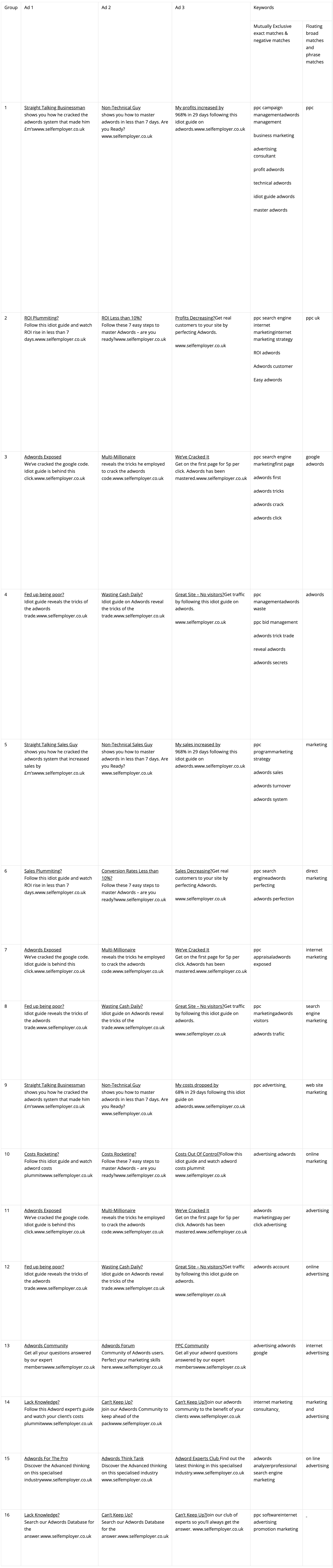
I would carry on allocating the relevant keywords to each ad group which I thought suited. This would be because either the search term was in the advert or the search term tended to the type of customer catered for in the ad group.
Let me define them for you.
Broad Matches
A broad match means that anything that is searched containing similar words in your phrase means that your ad might show. So using the example of a broad match:
Now you may want the last 3 phrases to deliver your ad but you may not want the first one to. This is because the person typing that phrase in is looking for a job rather than help with building their marketing strategy. To avoid attracting the wrong type of searcher you use what is known as negative matching.
Negative Matches
Using the same example as above you would simply put a negative sign before the word job like this:
-job
This means that anyone who searches for job with any of your words in your list your ad will not show.
Phrase Matches
Phrase matches mean that the sequence of words have to be correct for you ad to show. Other words can be included either side of the phrase but the sequence of the phrase cannot be altered nor words added in between. You do this by putting quotation marks around the phrase. So for:
This is because the sequence has changed or words have been added in between the phrase.
Exact Matches
Exact matches means that what is typed in by the searcher matches exactly with your key phrase. To do this you put square brackets round the phrase. So for:
Using These Tools
All these tools being negative, phrase and exact matching help reduce when you ad is shown. But why would we want that? Well this improves your click thru rate. And as shown above the better your click thru rate the less you pay for the same ranking.
You have to look at where you phrases could be confused with another completely different (and therefore irrelevant) business or subject. So if you were a used bike retailer using the phrase:
Your ad will show when someone searches for:
The person searching using this phrase will not be interested in your site and hence not get a click even though you have been aired hence your CTR will go down.
So my keywords in my above list will be ‘cleaned’ up by using these tools.
Trade Names & Misspellings
This is an excellent way to boost your chances for getting your ad aired. You have to include:
So I would include all my competitors (found thru google!) and all conceivable misspellings. So one of my competitors is named Perry Marshall so I would include the following search terms:
I would also include misspelling of the search terms used above so I would include:
Hopefully you can see now that I would generate keywords and phrases running well in excess of a thousand targeted keywords being relevant keywords, phrases, misspellings and trade names. This is now our starting list.
Set Bid Price For Each Search Term
I would set the maximum price for all search terms at the start and refine it later. Now what you set it at is up to you depending on what type of person you are. I like to set it high and really go for it to see if the idea works where others set it low and increase it over time and others set it to get a certain ranking (usually 1 to 8 so they get on the first page). I reckon you should try it all out and see what you feel most comfortable with at the start.
Part 7 deals with the analysis of these keywords because trust me, some (and possibly most!) will NOT perform.
Test, Monitor & Revise
Okay, we’ve written 48 ads, come up with around a thousand keywords and linked it all together. We now need to see what’s working and what’s not. I would suggest you give it a few days before you start making any brash or wild judgements on what is working or not.
When you log in to your google adwords account you will be able to look in to the campaign at the actual ad groups. What you need to do to determine whether its working or not is to see whether the:
So looking at your list of ad groups you will see:
Default Bid – This is the maximum Cost Per Click (CPC) you are willing to pay for someone to click on your ad. This you would have set at the start.
Clicks – This will be the number of clicks you ad has received.
Impressions – this is the number of times your advert has appeared after someone has searched for one of your specific terms.
CTR – This is the Click Thru Rate (CTR). This is Number of clicks divided by the number of impressions expressed as a percentage.
Avg CPC – This is the Average Cost Per Click. So this the total cost of clicks divided by the number of clicks.
Cost – this is the total amount you have spent on clicks.
Avg Pos – This is the average position your ad has appeared. So if it is in position 1 to 8 it will be on the first page of google. Its an average so it will be expressed to 1 decimal place.
So to determine whether your ad has been aired enough look at the number of impressions for each ad group. If you haven’t had your advert aired at least 1000 times in a week then either your subject has either no interest, you do not have enough search terms or your not bidding high enough. So rather than writing off your project straight away and saying there is no interest I suggest you increase the number of search terms first then increase the bids.
Increasing the number of search terms – You do this by repeating “Getting the Keywords” section in part 6 of this chapter or visit www.MassiveAndPassive.co.uk/get-keywords.html, You have to think of more search terms to add so that you have more chances of getting your advert aired. Not until you have 10,000 keywords linked to your ads can you ever say that you have enough keywords.
Increase the bid for all search terms – If you increase the bid amount you will sometimes increase your chances of getting aired as you may outbid a competitor and rise the rankings of your ad. This will cause your average position to rise and you will get aired more often. How much you have to increase it by is unknown as it depends on your competitors. Sometimes I just double my max bid for a day and see what happens. I like to find out if my idea is going to work quickly rather than playing it too tentatively and then flog a dead horse. But this all depends on your budget. I have fallen foul of this and spent £232 in one day on clicks!
Doing the two things above of increasing the amount of search terms and increasing the bids will result in more impressions. Once you’re over the 1000 mark we can then start making some revisions to the campaign. You should really aim for 1,000 impressions a day from then on in to really push your website. One of my websites gets over 200,000 impressions a day! This is because I have thousands of search terms, pay up to £1.27p a click and the subject is really popular, being property.
2.Getting Your Adverts Clicked
As mentioned above this is all about relevancy and the strength of your ad. I am going to assume you have eliminated all search terms that are irrelevant as it is quite obvious when a search term is not relevant. You must remove all search terms that are not relevant as this will reduce your click through rate thus google will charge you more for your clicks.
Now if your ads are getting aired but not clicked then there is something wrong with your ad. What google does is air your 3 ads per ad group and “split tests” the ads to find the best performer. So at the start google airs all 3 in rotation and at some point chooses a winner.
It may be obvious to google which is the winner if after a few thousand impressions the same ad keeps on getting clicked. If this is the case then google will just air this one as this is the one that makes google the most money! They want users to click so you get charged and google gets paid. A good click through rate for google is 0.5%.
If its not that obvious then it will air until they’re able to do so. Google may never make a choice if they work all pretty much the same. So you have 2 choices:
So if you are trying to beat the performance of an existing ad then I suggest keeping the structure and wording the same but consider:
Only make one deviation from the top performing ad and see which performs better. So you can have your top performing ad and then 2 other ads with one alteration each from the best performing ad.
So for example if the following ad was the top performer:
The other 2 ads trying to beat this ad would be:
With the exclamation mark added in ad 2 and capitalisation in the display url in ad3.
If either ad 2 or ad 3 perform better i.e. have a higher click through rate then this becomes the top performer and another alteration is made to try and beat this ad. And then all you ever do is try to beat the top performing ad.
Conversion Rate & Cost Per Conversion
Another clever thing you can do with google adwords is track a “sale” from a search term. This is helpful because you can track which search terms perform better than others. So for example you may have the search term “blue widgets” so not only can google tell you:
but google can also tell you:
The conversion rate – this is the number of times after someone clicked the visitor has actually bought from your site from a single search term. In other words the click has converted in to a sale. So you may have had 100 click throughs from the term “blue widget” and 3 sales might have occurred from those 100 visitors. This would equate to a 3% conversion rate. You also may have had 100 visitors from the search term “red widget” and 1 sale might have occurred from these 100 visitors. This would equate to a 1% conversion rate. So you could compare the search terms and deduce that “blue widget” search term converts better than “red widget” search term as 3 out of every 100 click throughs from the search term “blue widget” result in a sale compared to only 1 out 100 click throughs for the term “red widget”.
This is very powerful information. This means that you can bid higher for the term “blue widget” because you know that it is 3 times more effective than the term red widget. So take for example that both blue widgets and red widgets give you a profit before advertising of £10 per sale you know that for every 100 clicks on blue widget you make £30 and for every 100 clicks on red widgets you make £10.
So to break even for blue widgets you can spend £30 per 100 clicks or 30p per click and for red widgets you can spend £10 per 100 clicks or 10p per click. So you can see that you can adjust your bidding strategy on the performance of the terms you choose based on how well they convert. In this example the term “blue widget” is worth bidding higher than “red widget” as it makes you £30 per 100 clicks compared to £10 per 100 clicks.
Cost Per Conversion – This is means literally as it reads. This is the cost it took you in clicks to get one sale expressed as an average. So if you spent £200 on clicks and got 10 sales then the cost per conversion would be:
£200 / 10 = £20.
So the cost per conversion equals £20. So on average the spend on clicks to get a sale is £20. You can get this data over any time period by just adjusting the dates within google adwords so you can track whether over a specific period of time its cost your more or less to get a sale.
This figure is very important as it can tell you whether you are spending too much to get a sale. As for the same reasons above if you are spending £20 to get a sale but the profit on the item is only £10 before advertising then you are paying too much for the clicks because £10 – £20 = £10 loss!
So it is a good idea to monitor the cost per conversion for the last 7 days and make sure it falls within your budget. Please note gather the data for the last 7 days because this will give you a decent average based on current sales. If you do it for the time period of when you began the data becomes less unreliable because it averages it out over a longer period of time. Depending on the number of sales you get it may be that you can do gather data for less than 7 days (if you sell many items) or greater than 7 days (if you sell very few items) so that you get a good sample size to make accurate judgements.
Where and how to set tracking up
The 2 statistics can be found in the last 2 columns on the Campaign page after “Avg.Pos”. To set up this feature is very easy. You just have to add a little text at the end of the destination url and a bit of copied code on the “success” page. Its very easy to do and google guide you through it and explain it in dummy fashion.
To do this go to www.MassiveAndPassive.co.uk/conversion.html
The lazy mans guide to Google Adwords
I sometimes create a Google Adwords campaign in 10 minutes just to see how well an idea is received. So if you cannot be bothered to do what I have said above then do this, it will take you 10 minutes or so:
Getting on Yahoo, Ask, MSN and Others
A question that should be springing to mind is – What about the other search engines?????? This is an excellent question. You have to ask is it worth advertising on the others. The answer to this is as always – it depends! It depends on one and only one thing:
So I suggest you make it work on google as this is the largest audience you’re going to get and google is the easiest and cheapest way to get visitors to your site. Have a look at the split of searches performed on the top 5 search engines in the UK for the month of September 2006:
So you can see that google has a half share of the market. If you make it work on Google then I suggest you advertise on Yahoo second (which includes you in Ask as well) and then MSN third. The others are worth doing if you are trying to squeeze every sale out of the searching population which may be applicable if you have only one product that you sell.
You need to equate whether its worth trying to master a Pay Per Click system over developing new products. I choose develop new products but others focus on their one or two products. Neither strategy is wrong or right! It will depend on you and where you want to take your website.
To find out how to get on to Yahoo, Ask, MSN and the other search engine Pay Per Click programs visit: www.MassiveAndPassive.co.uk/other-ppc.html